Coronavirus and Small Business Law Series: Protecting the Privacy of Children’s Images in Online Learning
THE CORONAVIRUS AND SMALL BUSINESS LAW SERIES
This blog post series provides key legal practices to help secure your business success during the Coronavirus pandemic.
As a result of this knowledge, then you can return to what you do best which is providing your service or product.
Today’s topic: Protecting Children’s Privacy in Online Learning
While scrolling through Facebook last week, I came upon a teacher’s post sharing a joyful moment teaching an online learning class.
How heartwarming to read stories of students adapting to the “new normal” online classroom. On the surface, this seems like the perfect uplifting post. However, the teacher included a snapshot of her virtual class with all students’ faces.
Most would find this absolutely adorable.
The lawyer in me gasps!
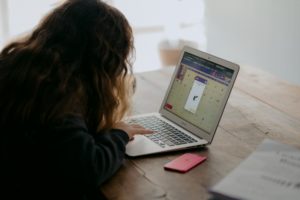
The coronavirus pandemic has forced school closures everywhere. In fact, to keep our young generation learning, remote classrooms came to the rescue. Notably, billions of children and teachers are now interacted through online learning.
Therefore, let’s be sure to protect the privacy of those children.
“Right to privacy is really important. You pull that brick out and another and pretty soon the house falls.”
– Tim Cook
Topic #6: Protecting the Privacy of Children’s Recorded Images in Online Learning
The Children’s Online Privacy Protection Act (COPPA) gives parents control over personal information collected from their children online. Personal information identifies an individual. For example, personal information can be an image, video or audio recording. Therefore, COPPA regulates the recording of children during online learning.
The Family Educational Rights and Privacy Act (FERPA) also applies to educational institutions funded by the U.S. Department of Education. FERPA gives parents rights with respect to their children’s education records. Video recordings of virtual classrooms qualify as “education records.”
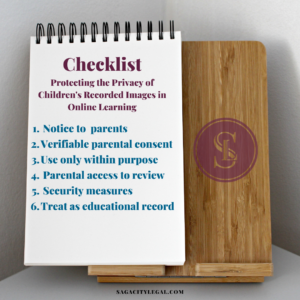
CHILDREN’S IMAGES IN ONLINE LEARNING : STEPS TO PROTECT
Do you just love checklists? Then, follow these steps to protect your students, your teachers, and your business.
Notice to Parents
Before you record your classroom instruction, notify the parents/guardians of your students. Actually, notify the parents/guardians before recording any online interaction with a child. This includes, for example, video chat tutoring.
Verifiable Parental Consent
Be sure to obtain verifiable parental permission for any and all recording. In simple terms, be sure each parent signs a parental release with a verified signature. Include intended and permissible purposes.
Use Only Within Purpose
Only use the recording for the intended purpose. Any other use requires separate permission. Do not, for example, post on social media, use in marketing campaigns, or share with non-students without parental permission.
Parental Access to Review
Allow parents access to review any recordings. Also, allow them to request deletion of a recording.
Security Measures
Maintain the confidentiality, security, and integrity of any recording. Share the recordings only with others who can also do so. This means that teachers’ devices should include verifiable security measures.
Treat As An Educational Record
Instruct online learning students to not share any personally identifiable information. A best practice is to have the students keep their cameras off and microphones muted during classes.
Start today: evaluate your current practices and take that first step to securing your success.
PROTECT YOUR STUDENTS’ PRIVACY. IT’S THEIR RIGHT, THE LAW, AND AN ALL AROUND GOOD IDEA.
Check out the entire Coronavirus and Small Business Law Serieshere.
Do you need help with securing the success of your online business? If you’re a Florida business or resident, I can help. Contact mehere.
About
Hi, I’m Randi.
I’m an IP attorney
My goal is to make legal guidance easy to understand, providing a supportive environment so you can feel confident securing your business’s future and focusing on what you do best.
This website uses cookies to ensure you get the best experience on our website. By clicking the Continue button you agree to our use of cookies, our privacy policy and our terms and conditions. Privacy Policy