

This website uses cookies to ensure you get the best experience on our website. By clicking the Continue button you agree to our use of cookies, our privacy policy and our terms and conditions. Privacy Policy
Why Making Your Website Accessible Matters
Website accessibility in its simplest terms is the capability for everyone, regardless of their ability, to access your website and content.
Disabilities come in many shapes and forms. The CDC defines a disability as: “… any condition of the body or mind … that makes it more difficult for the person with the condition to do certain activities … and interact with the world around them…”
When your website is designed for accessibility, you provide a service to people with a diverse range of hearing, movement, sight, and cognitive ability. An accessible website provides a great way to do business with many people with disabilities, therefore leading to more customers! It sure can help your business reputation too.
Interestingly, within the United States, there are not specific legal regulations for website accessibility. In fact, the ADA (Americans with Disabilities Act) does not actually provide for online compliance. With no written regulations, courts use their judicial discretion when website owners are sued for lack of accessibility.
Therefore, what should a business to do to make its website accessible?
Under these circumstances, follow the Web Content Accessibility guidelines!
Guidelines for Making Your Website Accessible
When you make your website accessible, therefore you benefit individuals, businesses, and society. In fact, international web standards define what is needed for accessibility. Accordingly, here’s a summary of the guidelines.
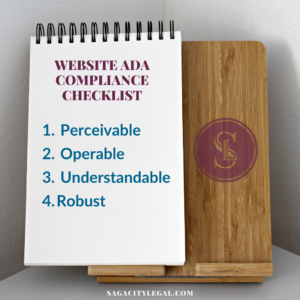
Perceivable
Your website content and user interface should allow for the use of many different senses.
To make a website more perceivable for people with disabilities
- Provide text alternatives for any non-text content therefore allowing it to be changed to other forms. (i.e. large print, braille, speech, symbols, or simpler language).
- Further, provide alternatives for time-based media.
- Moreover, creating adaptable content that can be presented in different ways (e.g., simpler layout) without losing information or structure.
- Also, create distinguishable content. Make your content easy for users to see and hear. One example: separate foreground from background.
Operable
Your website user interface and navigation should be operable by all users. In other words, refrain from interactions that some users cannot perform.
To make a website more operable for people with disabilities
- Make all functionality available from a keyboard.
- Provide users enough time to read and use content.
- Refrain from designing content in a way that may cause seizures.
- Provide ways to help users navigate, find content, and determine where they are.
Understandable
Be sure the information on your website is understandable to all users. In other words, the content or operation cannot be beyond their understanding. I think of this as the “keep it simple” rule.
To make a website more understandable for people with disabilities
- Make text content readable and understandable.
- Make web pages appear and operate in predictable ways.
- Help users avoid and correct mistakes.
Robust
Be sure you create robust content that can be interpreted by a variety of user agents, including assistive technologies. As technologies and user agents evolve, your content should remain accessible.
To make a website accessible and more robust for people with disabilities
- Maximize compatibility with current and future user agents, including assistive technologies.
Implement these guidelines to make your website accessible; and users with disabilities will thank you!
Check out my other blog posts for more information on Your Website and the Law.
Contact me for a free website legal review today!
About

Hi, I’m Randi.
I’m an IP attorney
My goal is to make legal guidance easy to understand, providing a supportive environment so you can feel confident securing your business’s future and focusing on what you do best.
About RandiSearch By Category